

Introduction to the Church Year
An Introduction to the Church Year
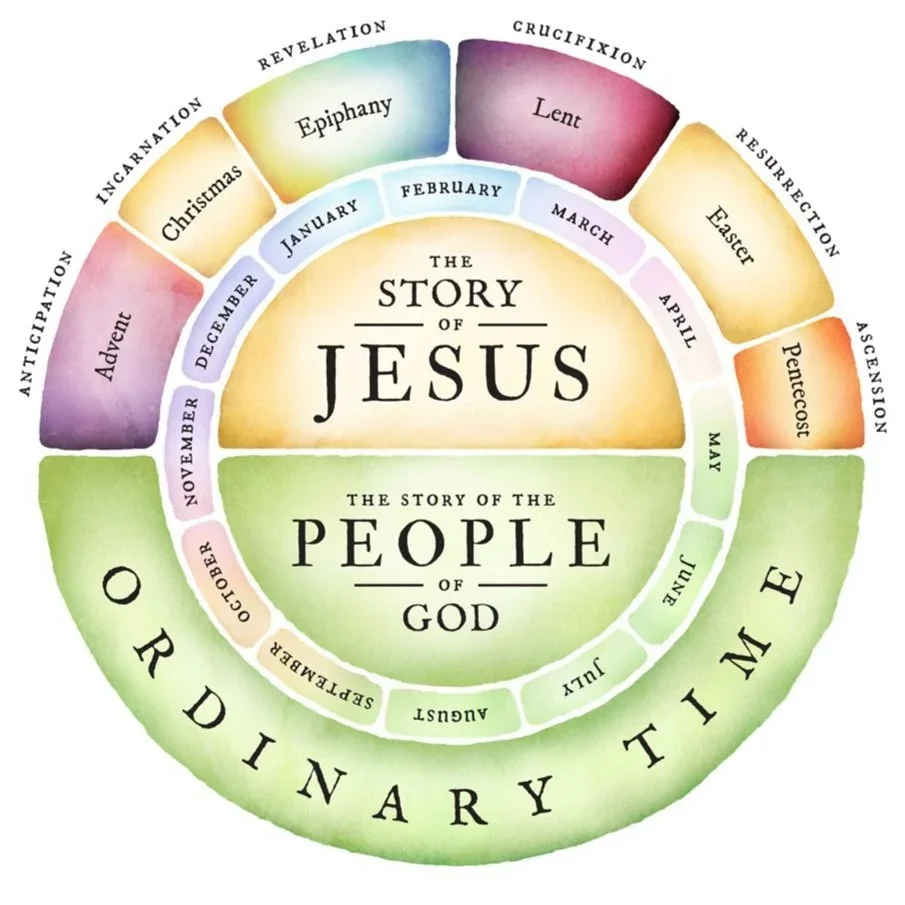
If you’re new to the Lutheran tradition—or to any church that follows the historic liturgical year—you might wonder why the calendar feels so different from the one hanging on your wall at home.
The Church Year is not just a schedule, it’s a story. And even more—it’s your story in Christ.
Instead of structuring our spiritual lives around deadlines, sports seasons, school calendars, or holidays created by marketing teams, the Church Year invites us to structure our lives around the life of Jesus. Every season helps us remember, celebrate, and enter more deeply into what Christ has done for us and what He is doing in us.
It’s a way of saying, week after week: “My life is hidden with Christ.” (Col. 3:3)
Let’s walk through these seasons together.
Advent — Anticipating the Coming Christ
Advent is the beginning of the Church Year—a season of waiting, longing, and expectation. It stands in quiet contrast to the frenzy of December. Here we slow down and learn to pray: “Come, Lord Jesus.”
We remember His first coming in Bethlehem.
We recognize His coming to us now through His Word and Sacraments.
We anticipate His final coming to make all things new.
Advent trains our hearts in holy longing—teaching us to desire Christ above all.
Christmas — Celebrating God Coming in the Flesh
At Christmas, the waiting gives way to wonder. For twelve days, the Church celebrates what Christians call the Incarnation—God taking on human flesh. Not a myth. Not a metaphor. God actually came among us. Christmas tells us that God is not distant, but near. Not abstract or cold, but embodied and compassionate.
This season invites us to marvel at the humility, tenderness, and glory of Jesus—God with us.
Epiphany — Christ Revealed as Savior of the World
After Christmas comes Epiphany, a season of light. The word epiphany means “revelation,” and this season focuses on moments when Jesus’s identity shines clearly—His baptism, His miracles, His teaching, His call to the nations.
If Christmas tells us who He is, Epiphany shows us what He came to do: bring salvation to the whole world. It’s a season that expands our vision and enlarges our love.
Lent — Preparing for Holy Week
Lent is a season of repentance, reflection, and returning to the Lord. It’s not about earning God’s favor—Christ already won that for us. Lent simply helps us see how much we need Him and invite the Spirit to cleanse our hearts from the sin and distractions that keep us at arms distance. During these forty days, we echo the ancient prayer: “Create in me a clean heart, O God.”
This season trains us in humility, honesty, and hope as we prepare for the central story of our faith.
Holy Week — The Heart of the Christian Story
Holy Week brings us to the center of it all.
Palm Sunday — Jesus enters Jerusalem as King.
Maundy Thursday — He gives us His body and blood in the Supper.
Good Friday — He dies for the sins of the world.
Holy Saturday — He rests in the tomb.
Easter Sunday — He rises in victory.
This is the week that changed the world—and changes us. Holy Week invites us into the depth of Christ’s love, the weight of His sacrifice, and the joy of His resurrection.
Pentecost — The Spirit Sends Us Into the World
Fifty days after Easter, we celebrate Pentecost—the moment when the Holy Spirit descended on the disciples and the Church was filled with power.
Pentecost reminds us that:
The Christian life is Spirit-enabled.
The Church has the glorious tasks of sharing Jesus with the world.
Christ continues His work through us.
What begins at Pentecost continues today in every congregation—including ours—as the Spirit forms Christ in us and sends us out as His witnesses.
Why the Church Year Matters
For many who are new to this tradition, the Church Year becomes one of the most meaningful discoveries of their Christian life. It gives:
Beauty
Each season paints a different facet of the gospel—light, joy, repentance, hope, victory.
Stability
In a chaotic world, you’re rooted in something older, deeper, and steadier than culture’s constant changes.
Formation
The Church Year shapes your heart over time, teaching you to live your days in step with Christ.
Joy
You don’t just learn about Jesus—you journey with Him.
Walking through the Church Year is like walking through the gospel again and again until it becomes part of you.
Your Invitation to Enter the Church Year
The Church Year isn’t just an idea or a history lesson—it’s a lived journey of formation, worship, and joy. It’s a way of letting the life of Christ shape the rhythm of your life… week by week, season by season, promise by promise.
And you’re invited to step into it with us.
At Trinity San Antonio, we walk this sacred path together—waiting in Advent, rejoicing at Christmas, beholding Christ in Epiphany, slowing down in Lent, standing in awe during Holy Week, and living in the Spirit’s power throughout Pentecost. Every Sunday is a doorway deeper into the story of Jesus and into the life God is forming in us.
If you’re longing for a church family, curious about historic Christian worship, or simply ready for something deeper and more rooted—come join us.
Visit us this Sunday at 10:30am and begin the journey. We’d love to walk it with you.
~ Pastor Matthew Ballmann

Liturgy of Holy Communion (Part 1) - The Preface

Introduction
The Eucharistic prayer opens with a three-part dialogue that has been recited in the Church since at least the third century. This dialogue is first reported in the Eucharistic prayer of St. Hippolytus (c. A.D. 215). Now, eighteen centuries later, we continue to say the same words, uniting us with the Christians of the early Church.

The Lord’s Presence
The opening exchange (“The Lord be with you… and also with you/spirit.”) we have heard before. It is used in the introductory rite of the start of the Divine Service just before the reading of the Scriptures. Greetings like this were used through Scripture to address those whom God called to an important but daunting missions. Isaac (Gn 26:3, 24) and Jacob (Gn 28:13-15); Moses (Ex 3:12) and Joshua (Josh 1:5, 9); Gideon (Jgs 6:12), King David (2 Sam 7:3), and the prophet Jeremiah (Her 1:6-8), and the Blessed Virgin Mary (Lk 1:28). All of theme heard this message at pivotal moments in their lives. They needed the Lord to be with them as they set out on their charge.
Here, the greeting is fittingly repeated as we embark upon the most sacred part of the service: the eucharistic prayer. Both the pastor and the people need the Lord to be with them as they prepare to enter the mystery of Holy Communion.
Question: Why is it important that we are reminded of God’s presence with us?

Lifting Our Hearts
Next, the pastor says, “lift up your hearts” (Latin: literally, "Upwards hearts"). This prayer brings to mind the exhortation in Lamentations 3:41, “Let us lift up our hearts and hands to God in heaven.” What does it mean to “lift up” our hearts?
In the Bible, the heart is the hidden center of the person from which one’s thoughts, emotions and actions originate. All intentions and commitments flow from the human heart. Therefore when you are invited each week to “lift up your hearts,” we are being summoned to give our fullest attention to what is about to unfold. This is a wake up call to set aside all other concerns and focus our minds, wills, and emotions - our hearts - on the sublimity (grandeur, beauty, excellence) of what is happening in the Eucharistic prayer.
This summons is reminiscent of St. Paul’s words to the Colossians 3:1-2, “If then you have been raised with Christ, seek the things that are above, where Christ is, seated at the right hand of God. Set your minds on things that are above, not on things that are on earth.” Just as Paul called the Colossians to seek the “things above, where Christ is,” so are we bidden to direct our entire being towards the things of heaven, for that is where Christ is. And that is where we are going in the Eucharistic prayer.
Our Fullest Attention
St. Cyprian (d. A.D. 258), a North African Church Father, explained how this prayer draws our attention away from worldly distractions and is meant to lead us to ponder the awe-inspiring action taking place in the Eucharist prayer:
“Moreover, when we stand praying, beloved brethren, we ought to be watchful and earnest with our whole heart, intent on our prayers. Let all carnal and worldly thoughts pass away, nor let the soul at that time think on anything but the object only of its prayer. For this reason also the priest, by way of preface before his prayer, prepares the minds of the brethren by saying, Lift up your hearts, that so upon the people's response, We lift them up unto the Lord, he may be reminded that he himself ought to think of nothing but the Lord.”
Another Church Father, St. Cyril of Jerusalem, made a similar point and warned believers of the seriousness of this moment:
“Lift up your hearts: for in this sublime moment the heart should be lifted up to God, and not be allowed to descend to the earth and to earthly concerns. With all possible emphasis the priest exhorts all in that hour to dismiss all cares of this life, or household anxieties, and to have their heart in heaven with the merciful God. Then you answer, We lift them up unto the Lord: assenting to it, by your avowal. But let no one come here, who could say with his mouth, We lift up our hearts unto the Lord, but in his thoughts have his mind concerned with the cares of this life.”
Cyril goes on to acknowledge that being attentive to the Lord is something we should do always, but is difficult because we are fallen and weak. Yet if there ever is a moment to concentrate most intently and give God our fullest attention, it is now at the Eucharist prayer: “We should, indeed think of God at all times, but this is impossible because of our human frailty; but in this holy time especially our hearts should be with God.”
Question: Why can it be difficult for us to keep our minds and hearts focused on Christ?

Giving Thanks to God
In the last exchange the pastor says, “let us give thanks to the Lord our God.”
As we have already expressed after each Scripture reading (“Thanks be to God”), thanksgiving is a common biblical response to God’s goodness and to His saving works in our lives. In fact, thanksgiving is (should be) the most basic posture of God’s people towards Him.
We are reminded to give thanks to the Lord and echo the similar exhortation found in the Psalms: “Give thanks to the Lord for He is good…” (Psalm 136:1-3; see also Ps 107:8, 15, 21, 31).
St. Paul similarly teaches that the Christian life should be marked by prayers of thanksgiving. We should be “abounding in thanksgiving” (Col 2:7), give thanks to God in all we do (Col 3:17) and “in all circumstances” (1 Thess 5:18, Phil 4:6), especially in worship. Read the following Scripture passages: 1 Cor 14:16-19; Eph 5:19-20; Col 3:16. Following this biblical tradition of offering prayers of thanksgiving, the congregation responding, “It is right to give Him thanks and praise.”
Question: What is the point of agreeing with the prayer and saying “it is right”? How does giving thanks for all God has given and done for us change our attitude and outlook on life?

The Two Comings of Christ - Cyril of Jerusalem
We preach not one advent only of Christ, but a second also, far more glorious than the former. For the former gave a view of His patience; but the latter brings with it the crown of a divine kingdom. For all things, for the most part, are twofold in our Lord Jesus Christ…. In His former advent, He was wrapped in swaddling clothes in the manger; in His second, He covers Himself with light as with a garment. In His first coming, He endured the Cross, despising shame (Hebrews 12:2); in His second, He comes attended by a host of Angels, receiving glory. We rest not then upon His first advent only, but look also for His second. And as at His first coming we said, Blessed is He that comes in the Name of the Lord , so will we repeat the same at His second coming; that when with Angels we meet our Master, we may worship Him and say, Blessed is He that comes in the Name of the Lord. The Savior comes, not to be judged again, but to judge them who judged Him; He who before held His peace when judged , shall remind the transgressors who did those daring deeds at the Cross, and shall say, These things have you done, and I kept silence. Then, He came because of a divine dispensation, teaching men with persuasion; but this time they will of necessity have Him for their King, even though they wish it not.
Cyril of Jerusalem, Catechetical Lecture 15

Teach Advent to Your Family
Busy parent looking for easy ways to teach your kids about Ash Wednesday?
Easy Ways to SLOW DOWn and Teach Your Family About Advent

Well it’s not even Thanksgiving and Hobby Lobby is already clearancing their Christmas decorations. Believe it or not, next Sunday is the first Sunday of Advent (it completely caught me by surprise this year). It’s so easy to race through the “holidays” from one plan to the next. This is the wisdom of the church year in giving us space to focus on one season at a time. Twice in the church year a massive holy day is preceded by a season of preparation. Many of us are used to giving something up for Lent (to prepare our hearts for Easter). But it can be so difficult to wait in the season of Advent. We want carols, lights, hot cocoa, and presents! These are all wonderful joys; but if there’s one thing you do this Advent season I want to encourage you to slow down, to wait in the longing for Christmas. This is the very reason for Advent. And for your kids (and mine!) that can’t wait for Christmas day and celebration and presents there are ideas below to help them (and you!) to slow down and anticipate the coming of Jesus. There’s several ideas below but I want to encourage you towards simplicity. Pick one or two that jump out. Go for quality over quantity. We’ll republish this blog next year and you can try out the others.
Attend aDvent Services
Okay I’m goin to cheat a little right off the bat and suggest you do this in addition to 1 or 2 other ideas. The Christian life is life in the local church. If you’re not already part of a congregation I want to cordially invite you to join us a Trinity San Antonio. We have a few Advent services this year. As well as our usual Sunday service, which we’d love to have you at! There’s tons of options below or you can read through them here.

Thanksgiving leftover potluck and wreath making: Bring your Thanksgiving leftovers and make an Advent wreath with provided real greenery. Sunday, November 27th; after service; at the Woehler Family Center.
Advent Midweek Service with Meal and Crafts: Join us in a brief worship service and a shared meal. Crafts for the whole family too! Wednesday, November 30th; 5:30PM; at the Woehler Family Center.
Saint Nicholas Party: Food and bonfire as we honor the spirit of generosity modeled by the historical Saint Nicholas of Myra. Wednesday, December 7th; 5:30PM; at Pastor Matthew Ballmann’s home.
Las Posadas: This has become a highlight for the whole year for my family. We’ll recreate the story of Joseph and Mary going inn to inn trying to find a place to stay. There’s songs, Mexican hot chocolate, a Mariachi band, piñatas, costumes, and of course buñuelos! Wednesday, December 14th; 6:00PM, outside the Woehler Family Center.
Christmas Eve Candlelight Service: Worship and anticipate the arrival of Christ ending in a beautiful candlelight moment. Saturday, December 24th; 4:00PM, at the Woehler Family Center.
Christmas Day Service: This year Christmas is on a Sunday! What better day to gather for the Divine Service than Christmas. Please join us at 10:30AM on December 25th at the Woehler Family Center.
PRactice Generosity
There’s no better season to give to others than Christmas, when God gave us His Son. The best thing about this idea is it can be as simple or complex at you like. You could:
Tell your kids to secretly give their family and friends gifts. Kids get a big kick out of the anonymity and it keeps the focus off ourselves.
Spend some time at a local retirement community. Often the elderly unfortunately get too few visitors and this can be difficult season for many to be alone. Kids are also a great addition to a visit and it can be a great opportunity for conversation.
Put together bundles for the homeless. Buy some warm clothes, socks, toothbrushes, and other essential items. Pack them up in bundles and put them in your car. When you see someone in need give the bundle! Or make a trip to a local shelter to deliver several.
Invite someone over for dinner. Those of us with families can take for granted our daily opportunity for community (or chaos). Invite a neighbor, a single friend, a military member you know over. They may not have a place to celebration traditions and opening your home can be a great way to share.
Read an Advent Devotional
Reading a daily Advent devotional at the dinner table is a super easy way to reorient ourselves around Jesus. There’s no shortage of good ones out there. For younger kids I’d recommend Counting to Christmas. We have copies of this at church on Sundays, our gift to you! Still doable with younger kids but one for older kids, or you and your spouse, is God Is in the Manger. This book features reflections from Dietrich Bonhoeffer that you can read in a few minutes.
This can be combined with the classic Advent Candles and wreath. Kids love to light and snuff the candles each night to countdown the days to Christmas.
You could also read from the Lectionary (remember we’re going to Series A this Advent). Here’s a handy link. Consider reading the passages multiple times each week.
While not a devotional this is a great season to learn about the historical Saint Nicholas. This is a beautiful book to read to your family.

Make an Advent Craft
Here’s a few ideas:
Buy (or make!) an Advent Calendar to countdown the days to Christmas
Make some Advent “stained glass” (these are paper crafts also some coloring sheets are there).
Come to the wreath making after Service on November 27th! Or grab some greenery and make your own.
Make your favorite Christmas cookies and combine with the idea about generosity and share with someone.
If your feeling ambitious you could make red and white striped candy canes. You can talk about how they look like a shepherd’s crook (like the shepherds who witnessed the birth of our Good Shepherd or it’s a J for Jesus!), the red for the blood Jesus spilled to make us white as snow.
Listen to Advent Music
Just wait. You can wait to play your favorite Christmas music. I know it’s hard (okay even I cheat). But there are tons of wonderful Advent songs that have us sit in anticipation and longing. Maybe you can even make it practical but talking about patience with the kids. Here’s a playlist to get you started.
Add to Your Homeschool or Supplement School
If you homeschool your kids, add Advent and Saint Nicholas to your classes. Read Advent scriptures. And definitely make sure to include color pages and other fun worksheets. There’s plenty of resources out there even for Lent specifically. Definitely check out: https://www.lutheranhomeschool.com/. We also love the site https://www.teacherspayteachers.com/ (note you do need a free account). You can search for Advent or Saint Nicholas and filter to free (just make sure to review the content before handing to your kiddos). And bust out those purple crayons since that’s the Advent liturgical color.
If you don’t homeschool I encourage you to supplement your kid’s classroom learning. Any of the above can be added as “homework” or done as a mini class after school around the diner table.
More Ideas
If you’re still hungry for more recommendations, check out our previous years’ blogs here and here.
Whatever you do, or don’t, make it intentional and talk about it! Even one little activity with some good conversation will go a long way to bring your children, and your family, into preparation for the majesty of Christmas. Blessings on your Advent season!
About the Author
David Hein is a member of Trinity San Antonio with his wife Mindi and three boys: Kirk, Wesley, and Caleb. He is a first year seminarian at Lutheran Brethren Seminary. The picture below is the closest they’ve gotten to one with everyone’s eyes open.


Teach Ash Wednesday to Your Family
Busy parent looking for easy ways to teach your kids about Ash Wednesday?
Easy Ways to Teach Your Family About Ash Wednesday (And maybe Lent…)

Perhaps you’re like me staring at three unruly boys and wondering how do I teach these lovable miscreants about Ash Wednesday? No matter the number, age, and gender of your children it’s a simple fact us parents are long on aspiration and short on time. So this sleepless parent thought he’d share his findings on some easy ways to teach your whole family about Ash Wednesday (and a little bit of Lent too). Before we dive in, let me offer a piece of advice: make a plan, keep it simple, and participate in Church. If you don’t have a church home I cordially invite you to join us at Trinity at 10:30 AM on Sundays.
Review the Previous Blog Posts
If you haven’t already, read the two great blog posts Pastor Matthew has put together here and here summarizing Ash Wednesday and Lent, respectively. If you’re old hat to the church year or brand new it will help to brush up on the basics for your young, inquiring minds.

Attend an Ash Wednesday Service
One of the best ways we can catechize our children is faithful attendance to church. Ash Wednesday is an especially great one for kids because of the tactile imposition of the ashes. Kids love stuff and textures. The feel of the gritty yet smooth ash on their foreheads is something you can discuss with them to hype the anticipation. Plus you can talk about how we sacrifice a Wednesday evening to gain an encounter with Christ. Lent is all about sacrifice that allows space or resources for God’s work. What better way to start the season than gathering with brothers and sisters in Christ.
Sacrifice and Serve as Family
If you know one thing about Lent it’s the tradition of giving something up: coffee, rich food, social media, Netflix or other streaming services. Too often though we can treat this as our second chance at New Year’s resolutions. It’s certainly good to intentionally work on self improvement; but it falls short of the fuller vision for Lent. Fasting and self-denial are meant to create space for almsgiving (generosity). Maybe your family goes out to eat or orders in once a week; choose to forgo that luxury and instead donate the money to a food bank. Perhaps family movie night is sacrificed for a night of prayer. Consider skipping a kid’s event (sports, drama, etc.) to go serve as a family. There’s endless options; but definitely talk about it as a family and discuss the why.
With older kids consider an actual fast day (Friday is a great choice in remembrance of Good Friday). You could cut out meat, eat simply (bread and water), or consider a full day without a meal (I find sundown Thursday to sundown Friday works well). Again don’t just focus on the sacrifice use the extra time or money purposefully.
Read or Memorize Psalm 23
David’s most famous Psalm is also a great one for Ash Wednesday. “Even though I walk through the valley of the shadow of death I will fear no evil” (verse 4). We are reminded that the LORD truly is our Shepherd who guides our lives, gives us rest, saves us, and one day we will dwell not in the sadness and pain of death (from dust to dust) but we will dwell in the “house of the LORD”. It’s also a great Psalm for kids to read (short, not too difficult) and a must memorize passage of Scripture.
Again with older kids I’d commend following the lectionary as a family. The Ash Wednesday passages are the same regardless of year: Joel 2:12-19, 2 Corinthians 5:20-6:10, and Matthew 6:1-6, 16-21. Throughout Lent there are additional readings provided by the historic church. Our church is in Series C of the Three-Year cycle (easy link here). Typically you’ll read the week’s passages twice with the Old Testament reading on Monday and Thursday, Epistle on Tuesday and Friday, Gospel on Wednesday and Saturday; but there is complete freedom in what works for your family.

Make a Lenten Chain
You’ve likely heard of (or eaten) Advent calendars. Those 24 or 25 boxes of chocolates that count from December 1 to Christmas. There’s a beautiful practice for Lent that’s similar. You make a series of paper loops like the image on the right. Each day you’ll tear one off to count down to Easter. There’s an easy link here. You could also go a step farther and write things to pray for. Or perhaps use this Lenten Guide for activities you can add to each loop. Better yet, have your kids come up with their own! Another fun “craft” is making pretzels. They are somewhat bland which is good for Lent and the shape looks like arms folded in prayer.
Listen to Lenten Music
Kids love music. Find or create a playlist of Lenten specific hymns. Sing them as a family. Here’s two to get you started: one and two.
Add to Your Homeschool or Supplement School
If you homeschool your kids, add Ash Wednesday and Lent to your history units. Read Lenten scripture. And definitely make sure to include color pages and other fun worksheets. There’s plenty of resources out there even for Lent specifically. Definitely check out: https://www.lutheranhomeschool.com/. We also love the site https://www.teacherspayteachers.com/ (note you do need a free account). You can search for Ash Wednesday or Lent and filter to free (just make sure to review the content before handing to your kiddos). Or here’s a direct link to some coloring pages. And bust out those purple crayons since that’s the Lenten liturgical color.
If you don’t homeschool I encourage you to supplement your kid’s classroom learning. Any of the above can be added as “homework” or done as a mini class after school around the diner table.
Whatever you do, or don’t, make it intentional and talk about it! Even one little activity with some good conversation will go a long way to bring your children, and your family, into preparation for the glory of Easter. Blessings on your Lenten season!
About the Author
David Hein is a member of Trinity San Antonio with his wife Mindi and three boys: Kirk, Wesley, and Caleb.



The Spiritual Pilgrimage of Lent
Your invitation to The Spiritual Pilgrimage of Lent

What is Lent?
Lent is a season of the historic church year passed down from the earliest days of the church and observed from Ash Wednesday to Easter. It is 40 days in length not counting Sundays which are considered min-Easter celebrations. Because Lent lasts for 40 days it recalls Christ’s fasting during his temptation/testing in the wilderness (Matthew 4:1-11). Lent is a penitential season that is marked by the stripping away of those things which compete for our allegiance to Jesus.
Like a pilgrimage where one encounters places they don’t normally tread, so Lent takes us on a spiritual pilgrimage through our own wilderness right up to the foot of the cross on Good Friday and into the glorious empty garden tomb of Easter morning. By saying yes to Lent you say yes to an unexpected, challenging, and rewarding pilgrimage in which you come to know yourself and Christ’s love for you more deeply.
why should I consider entering into the spiritual pilgrimage of Lent?
It should be noted that there is no biblical mandate to observe Lent, nor does observing it earn us "browny points" with God. In Christ we are fully accepted and forgiven and nothing we do can cause God to love us more - Praise God! So why practice Lent? Lent is a physical and spiritual rhythm that helps us be conformed to the image of Christ. How so?
1) Observing Lent reminds us of our deep need for a Savior.
2) Observing Lent reminds us of the frailty and shortness of life and helps us reprioritize our lives (loves, desires, thoughts, actions, etc)
3) Lent prepares are heart for the celebration of Easter. If you want to grow in Christlikeness and experience spiritual renewal, Lent is for you.
How can I observe Lent this year?
There is no rule or law that you must follow to observe Lent, however, there are some time tested biblical practices we can learn from.
1) Gather with other believers in observing this Holy Season.
Join us at Trinity (or any congregation that follows the historic church calendar) for the special services and activities of the season. At Trinity we will be focusing on the theme of Lent on Sundays, as well as special mid-week events such at an Ash Wednesday Service, Vespers service, Stations of the Cross, Maundy Thursday, and Good Friday. We also will be coming together for mercy ministry projects throughout the season.
What the Super Bowl is to NFL fans, the final three days of Lent (“Paschal Triduum”) are to Christians. It is THE central three days that shook the universe. What happened in these three days that is so important? It marks the time that the God-Man willingly laid down His life for the sins of the world and not only paid the price for those sins but also conquered death by rising again! We mark these days with one service over three days that begins on Maundy Thursday where we remember where Christ instituted Holy Communion the the Church, continues into Good Friday where we remember Christ’s once and for all sacrifice for the sins of the world, and Holy Saturday where we celebrate the Easter Vigil/the conquering of death through resurrection. Let me invite, invest yourself fully in these three days. There is no more important activity than taking a few hours over these three days to reflect and meditate upon the Lord Jesus’ salvific work on your behalf. I strongly encourage you to make this a priority for you and your family.
2) The three historic practices:
Pick-up one of our Lenten guides on Sunday which will help guide you through the following three spiritual disciplines during the season. Here is also a helpful family Lenten guide.
Fasting - Fasting is the practice of giving up something perfectly good for the purpose of feeling it's lack in our lives. Fasting is never easy but always a huge spiritual blessing. Fasting can come in many forms but the type most mentioned in Scripture is fasting from food in order to dedicate ourselves to a season of prayer and repentance. Consider fasting from a single type of food (sweets, coke, alcohol, etc), a single meal every week, or maybe even a whole day every week (Friday's are traditional to remind us of Christ's betrayal on that day). It's common to fast (or partial fast) during holy week on Maundy- Thursday, Good Friday, and Holy Saturday. Other types of fasting include technology, tv, sports, music, etc. Pretty much anything can be fasted from. If this is your first time to observe Lent I encourage you to start easy and keep it simple.
Prayer - Prayer is pouring our heart out before God and listening to Him speak to us through His Word. Let's be honest, prayer is hard. It requires discipline to set the time aside and to not just pray for ourselves. Lent is a season we put a special focus on prayer in confessing our sins, asking God to change our hearts, praying for others, and the needs in the world. I encourage you to commit to finding a silent place to pray for 5-10 minutes every day. Set a timer and pray.
Almsgiving/Generosity - During this season we also place a special focus on those in need. We recognize there are many forms of need - emotional, spiritual, physical, etc). I would encourage you and your family to identify a need in our area - it could be a family, individual, ministry, etc - that you can give a special financial gift to. Who do you rub shoulders with that you know has need right now? It might be a few people or just one. Ask the Lord to place someone in your path and on your heart. Discuss it and prayer about it as a family.

Is Lent supposed to be hard?
Yep. In the same way that Christ fasted and was tempted in the wilderness before his ministry, so we too enter into a difficult season of self-denial. Self-denial pulls back the layers on what makes us tick, where we find comfort, how we respond to hardship, and forces us to rest in Jesus. It doesn't always feel spiritual but it will produce spiritual fruit as we ask the Spirit to work in our hearts and minds. God uses difficult season to purify us, Lent is such a season. Think of it like Marine bootcamp. Bootcamp is not an indefinite season but rather a short season to refine, equip, and purify the recruits.
An Invitation
The season of Lent is a gracious invitation offered to you. On Ash Wednesday our church hears the following invitation into this holy season:
Dear brothers and sisters of our Lord Jesus Christ, on this day the Church begins a holy season of prayerful and penitential reflection. Our attention is especially directed to the holy sufferings and death of our Lord Jesus Christ.
From ancient times the season of Lent has been kept as a time of special devotion, self-denial, and humble repentance born of a faithful heart that dwells confidently on His Word and draws from it life and hope.
I invite you, therefore, in the name of the Church, to the observance of a holy Lent: by self-examination and repentance; by prayer, fasting, and alms-giving; and by reading and meditating on God’s holy Word.
Let us pray that our dear Father in heaven, for the sake of His beloved Son and in the power of His Holy Spirit, might richly bless this Lententide for us so that we may come to Easter with glad hearts and keep the feast in sincerity and truth.
How to Celebrate the Resurrection of our Savior

Forty days of Lent is drawing to a close; we are walking through Holy Week and are about to arrive at the biggest celebration of the Church Year, Easter Sunday! But Easter isn't just one lone day at the end of weeks of fasting, prayer, and reflection. Easter Sunday kicks off the season of Easter, which lasts 50 days until Pentecost Sunday.
In the cycle of the Church Year, seasons of fasting are followed by seasons of feasting. So how can we press into a season of feasting and celebrating our Savior's resurrection for the next 50 days? Here are several ideas; hopefully you can find a couple that will work for you and your family this year!
Easter Sunday
It's a celebration, so let's party! A party looks different depending on the person, house and family you come from, but a party usually incorporates the five senses. There might be music, some fun activities, almost always good food, and maybe even some decorations. Think about how you want to celebrate Christ's resurrection tomorrow; maybe it's a playlist of Easter worship and hymns that you put on first thing in the morning, or your grandma's famous coffee cake for breakfast. It might be a special meal for dinner, or a banner that says "He is Risen!" You might want to fill your house with Easter lilies, yellow daffodils and pink tulips. Of all the days to go all out on a celebration, Resurrection Sunday is the day!
Even though we will be in our homes for worship services this year, we can still continue the sense of celebration by dressing up in our Easter best. If you have something white, you might want to wear it to remind yourself of your baptism and the new life we have in Christ!
The Week Following Easter
We can keep following Jesus' footsteps even beyond Holy Week. Here are two recommendations for you to try sometime during the week after Easter Sunday:
1. Fish for Breakfast
Read the beautiful story in John 21, where Jesus appears to the disciples and makes them fish and bread for breakfast. Yes, the resurrected Christ cooks breakfast for a bunch of fishermen! After you read this passage, go ahead and eat some fish for breakfast! Baked white fish with eggs and toast could be a place to start, but if you have a fire pit, wrap some fish in foil and make it really authentic. Or if fish for breakfast just isn't your thing, try going fishing after reading this passage.
2. Take an "Emmaus Walk"
Read Luke 24:13-35, and then take a walk with a neighbor, friend or your family and discuss a topic from Scripture, or talk about what it would have been like to be these followers of Jesus having this conversation on the road.
The Season of Easter
Here are some ideas for keeping the joy and celebration of the resurrection before us in the 50 days of Eastertide:
1. Listen to Easter music.
Use a playlist like this one or pick a different Easter hymn/song to learn each week during this season. You could sing this song every morning after breakfast or each night after dinner.
2. Keep your Easter decor up until Pentecost.
If you have a cross you could drape it with a white cloth, or maybe you want to make or purchase a special sign or banner that says," He Lives!" or "He is Risen!" to keep out during the season of Easter.
3. Party every week!
Pick a certain day of the week and plan a party on that day every week of Eastertide! It doesn't have to be complicated-you could have a Blue Bell ice cream party, a water balloon party, an Easter music jam session (if you're the musical type!), a game of hide and seek (read John 20:19 and talk about how the disciples went into hiding after Jesus' crucifixion), or a movie night (Maybe something like Ben Hur (1959) or Jesus of Nazareth (1977), or another family favorite. Be sure to preview before showing to your kids!).
4. Make or buy a special candle to remind you of the resurrection, and light it at breakfast or dinner each day during the season of Easter. Try this DIY idea.
5. Join Natalie every Monday of Eastertide for an Easter themed children's book read aloud on our YouTube channel:
The Feast of Epiphany

Epipha-what?
Epiphany, January 6, is the official end of the 12 days of Christmas. Many Christians celebrate this day by remembering the journey of the Magi who found their way to Jesus by following a bright heavenly body, usually represented by a star.
Epiphany means "revealing" or "manifestation" and historically was one of the three great feasts of the Church (Epiphany, Easter, and Pentacost). Originally, Epiphany (Jan 6th) was what Christmas (Dec 25th) is for us today, the celebration of the birth of Jesus. Today we retain both celebrations, with Christmas focusing on the birth of Jesus, and Epiphany focusing on the work of Jesus as the Light of the world. As with Christmas which is celebrated on a single day but also has a "season" following it (12 Days of Christmas), so Epiphany is celebrated on January 6th and has a season following it that runs until Lent begins, usually 5-9 weeks depending upon where Easter falls.
The major texts we tend to meditate upon during this season are the visitation of the magi, the baptism of Jesus, and the first miracle of Jesus turning water into wine. All of these events reveal who Jesus is as King of Kings, Son of God, and all-powerful. Each year as we read these events from Scripture, we are invited to experience anew the epiphany of Christ’ identity.
2 Timothy 1:9-10, “Who saved us and called us to a holy calling, not because of our works but because of his own purpose and grace, which he gave us in Christ Jesus before the ages began, and which now has been manifested through the appearing of our Savior Christ Jesus, who abolished death and brought life and immortality to light through the gospel,”
Epiphany is a time of great celebration and rejoicing. During Advent we spent four weeks waiting and anticipating the coming King, Christmas we celebrated his arrival and birth, and Epiphany we continue that rejoicing as we see Him manifest Himself as God and Savior.
Here are a few ways you can celebrate Epiphany with your family:

1) Chalk your Front Door with an Epiphany house blessing.

2. Have your kids make King crowns from craft paper

3) Bake a Kings Cake (Many bake a small figurine/toy baby into the cake to be discovered just as the magi discovered Jesus)

4. Save one Christmas gift for each child to be opened on Epiphany.

5. Break out the telescope for stargazing or visit an observatory.

6. Listen to some Epiphany music.
Prayer for Epiphany
O God, by the leading of a star You made known Your only-begotten Son to the peoples of the earth: Lead us, who know you now by faith, to your presence, where we may see your glory face to face; through Jesus Christ our Lord, who lives and reigns with you and the Holy Spirit, one God, now and for ever. Amen.
A blessed Epiphany to you and your family!
Observing Advent - Part II

As promised, here is the second installment of our Advent recommendations for you and your family! These are some extras to help you find ways to make this season of Advent a meaningful one. Book recommendations, ornaments with the names of God, and saints days are covered here; and scroll to the bottom for our Spotify Advent playlist!
Picture Book Recommendations
Books to read the day you put out Advent calendars and decorate your Christmas tree:
Waiting for Christmas: A Story about the Advent Calendar
The Legend of the Christmas Tree
Some beautiful picture books that are based on the biblical story of Christmas:
The Story of Christmas (Golden Book)
The Christmas Story According to Luke
Three great choices for telling the real story behind Santa Claus:
Saint Nicholas and the Nine Gold Coins
Saint Nicholas: The Real Story of the Christmas Legend
The Legend of the Christmas Stocking
Picture books based on the history of a Christmas carol, or containing the lyrics:
Silent Night, Holy Night (Traditions of Faith series)
A good book to read on Saint Lucia Day:
And some additional favorites:
The Christmas Miracle of Jonathan Toomey
The Year of the Perfect Christmas Tree
Reading Recommendations for Adults (or kids ready to listen to/independently read longer books and poetry)
Waiting on the Word: A Poem a Day for Advent, Christmas and Epiphany
The Christmas Stories and Poems of George MacDonald
This last book is actually a children's chapter book. The story follows an adventurous journey of a boy during the time of Christ's birth, and his journey intersects with the Christmas story throughout the book. Great family read aloud, although be aware you may need to edit out some of the scary scenes for younger listeners!
Ever Thine Home Ornaments

Ever Thine Home, a part of FamilyLife ministry, sells a variety of sets of different ornaments that focus on the names of God. One of these sets, His Eternal Names, includes a family devotional and activity that can be done throughout the month of December leading up to Christmas. You can find the details here.
Celebrate Special Saint's Days
1) St. Nicholas Day, December 6th
Did you know Saint Nicholas was a real person? He lived in Asia Minor in the third century, and was a Christian bishop. Legend has it that he was known for his generosity to those in need. One story tells of a poor family with three daughters who could never be married because their father didn't have the dowry money needed to arrange marriages for them. Nicholas secretly gave three bags of coins to this family by throwing them down their chimney; according to the legend, these bags landed in the daughter's stockings which were hanging up to dry.
On this day we like to read a book about St. Nicholas (see three good choices above) and discuss ways we can show generosity to others just as St. Nicholas did. This would be a great day to plan an act of service as a family! We also like to hang up our stockings on this day, and sometimes leave chocolate coins in the kid's shoes as well.
2) St. Lucia Day, December 13th
This is a day to remember Lucia, an early Christian martyr. This wealthy young woman used her dowry to help those in need. As legend has it, Lucia would travel into the catacombs where persecuted Christians were hiding, with candles on her head to free up her hands for the food she carried to them.
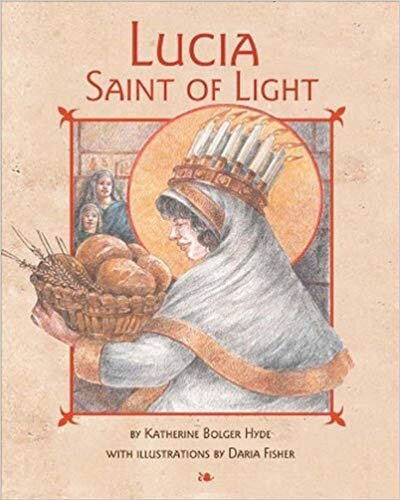
St. Lucia Day became particularly popular in Sweden, and is celebrated by having the oldest daughter in the family wear a crown of candles and deliver saffron buns and gingersnaps to her parents first thing in the morning on December 13th. We love to deliver these to friends and neighbors later in the day as well! See above list for a picture book biography to read on this day.
Our favorite recipes for this day:
Saffron Buns
Ingredients
3/4 cup milk
1/2 teaspoon saffron threads
1 teaspoon plus 1/4 cup sugar
One 1/4-ounce packet active dry yeast
3 1/2 to 4 cups all purpose flour
1/2 teaspoon kosher salt
1/4 cup butter, softened
1/4 cup of sour cream
2 large eggs
Raisins
1 egg, beaten
In a small pot, heat the milk, saffron, and 1 teaspoon of sugar together until the milk is steamy. Remove from heat and let cool until about 115°.
Sprinkle the yeast over the milk and let sit for 5 to 10 minutes until foamy.
Whisk together 3 1/2 cups of the flour, remaining 1/4 cup of sugar, salt.
Make a well in the center of the flour and add the yeast milk saffron mixture, the eggs, the butter, and the sour cream. Mix the ingredients until well incorporated.
Use a dough hook on a stand mixer (or mix by hand) on low speed. Slowly add additional flour, a tablespoon at a time, kneading to incorporate after each addition. Do this until the dough is still a little sticky to the touch, but does not completely stick to your hands when you handle it.
Shape the dough into a ball and place in a large bowl. Cover with plastic wrap. (Note at this point you can refrigerate overnight and bake in the morning.)
Let sit in a warm place for 1 to 2 hours, until the dough has doubled in size.
When the dough has doubled in size, gently press it down and knead it a couple of times. Break off a piece and form it into a ball about 2 inches wide. Roll the ball out into a snake, about 14 inches long.
Then curl the ends in opposite directions, forming an "S" with spirals at each end. Place on a lined baking sheet and repeat with the rest of the dough.
Cover with plastic wrap and place in a warm spot until the dough shapes double, 30 minutes to an hour.
Preheat oven to 400°F. Using a pastry brush, brush some beaten egg over the tops and sides of the uncooked buns. Place raisins in the centers of the "S" spirals.
Place in the oven and bake at 400°F for about 10 to 11 minutes (turning halfway through cooking to ensure even browning), until the buns are golden brown.
Remove from oven and let cool for 5 minutes before eating.
Gingersnaps
Ingredients
3/4 cup butter
1 cup white sugar
1 egg
1/4 cup molasses
2 cups all-purpose flour
1 tablespoon ground ginger
1 teaspoon ground cinnamon
2 teaspoons baking soda
1/2 teaspoon salt
1/2 cup white sugar for decoration
Preheat oven to 350 degrees F (175 degrees C).
In a medium bowl, cream together the butter and 1 cup white sugar until smooth. Beat in the egg and molasses until well blended. Combine the flour, ginger, cinnamon, baking soda and salt; stir into the molasses mixture to form a dough. Roll dough into 1 inch balls and roll the balls in the remaining sugar. Place cookies 2 inches apart onto ungreased cookie sheets.
Bake for 8 to 10 minutes in the preheated oven. Allow cookies to cool on baking sheet for 5 minutes before removing to a wire rack to cool completely.
Last but not least we have an Advent Spotify playlist for you! This playlist includes classic Christmas carols, but also some beautiful lesser known Advent hymns. Happy listening, and may this season be a blessed one for you and your family!
Feast of All Saints' Day
Helping families find ways to allow the life-giving truth of Christ to permeate day-to-day life is something we are passionate about here at Trinity! Following the church year can be a great way to do this, so today we are talking about All Saints' Day, celebrated on November 1st.

What is All Saints' Day?
Originally All Saints' Day was a day set aside to remember the martyrs of the early church, who had given their lives for their faith in Christ. Today we remember not only these martyrs, but all the faithful who have died in Christ, encompassing the faithful in the Bible, the early church, the more recent past, and even friends or family members who are now in heaven. 1 Corinthians 1:2 tells us that all who are in Christ are saints. The word "saint" is derived from a Greek verb (hagiazo) whose basic meaning is "to set apart, " "sanctify, " or "make holy." This title doesn't just belong to a select few Christians but to each and every person who has been forgiven in Christ Jesus. What Memorial Day is to America, All Saints’ Day is to the Church, a day of remembrance and thankfulness.
Why celebrate All Saints' Day?
All Saints' Day is a great opportunity to reflect on God's faithfulness, to thank Him for the example of faithful believers, and to be inspired by this example. This could be a great time to share with your kids about a faithful grandparent or mentor who God used to draw you closer to Him. You might want to read the story of a faithful saint from the Bible, or a biography of a missionary or early church figure. As we retell the story of the faithful Christians who have gone before, we give our children (and ourselves) a vision for what God could do through us, and our hearts are drawn in faith and praise to Him for His work throughout the ages in ordinary individuals just like us.
How can we celebrate All Saints' Day?
Here are a few ideas to choose from for celebrating this day with your family:
1) Attend a service at a church that celebrates All Saints' Day. At Trinity this Sunday Pastor Matthew will preach on this theme.
2) Read and discuss a passage of Scripture that talks about the saints throughout time, such as: Revelation 7:2-17.
3) Read a biography about a famous Christian from history. Here are a few of our favorites:
Trial and Triumph: Stories from Church History by Richard Hannula
Patrick: Patron Saint of Ireland by Tomie DePaola
Martin Luther: A Man Who Changed the World by Paul Maier
The Simonetta Carr biographies
Missionary biographies

4) Share about the life of a faithful Christian you knew personally who is now in heaven, and take a moment to thank God as a family for this saint.
5) All Saints Prayer to pray as a family
Almighty and everlasting God, You knit together Your faithful people of all times and places into one holy communion, the mystical body of Your Son, Jesus Christ. Grant us so to follow Your blessed saints in all virtuous and godly living that, together with them, we may come to the unspeakable joys You have prepared for those who love You; through Jesus Christ, our Lord, who lives and reigns with You and the Holy Spirit, one God, now and forever.
(Treasury of Daily Prayer)
Let's take some time this November 1st to thank God for the faithful that make up the body of Christ; in heaven and on earth, famous or little known, and to be encouraged to trust in His faithfulness to help us and our children run the race He has for us!